
Movement and fitness testing. Fast and easy.
Strength, power, endurance, mobility, coordination. No equipment, no set-up.
33 keypoints, one camera, no markers
Kinelitics technology screens athletes across the state for the Queensland Academy of Sport.




Record a test and get numbers back in seconds
A phone or tablet, a client, a few square metres.
- Nothing worn.
- Nothing calibrated.
1
Choose the tests
Pick a single test, or build a battery: strength, power, endurance, mobility, cardio-respiratory fitness.
2
Video the client
Point the camera and record. Nothing is attached to the client.
3
Read the result
Joint angles, depth, tempo and symmetry, per rep, in seconds. Show the client before they leave.
Read the numbers
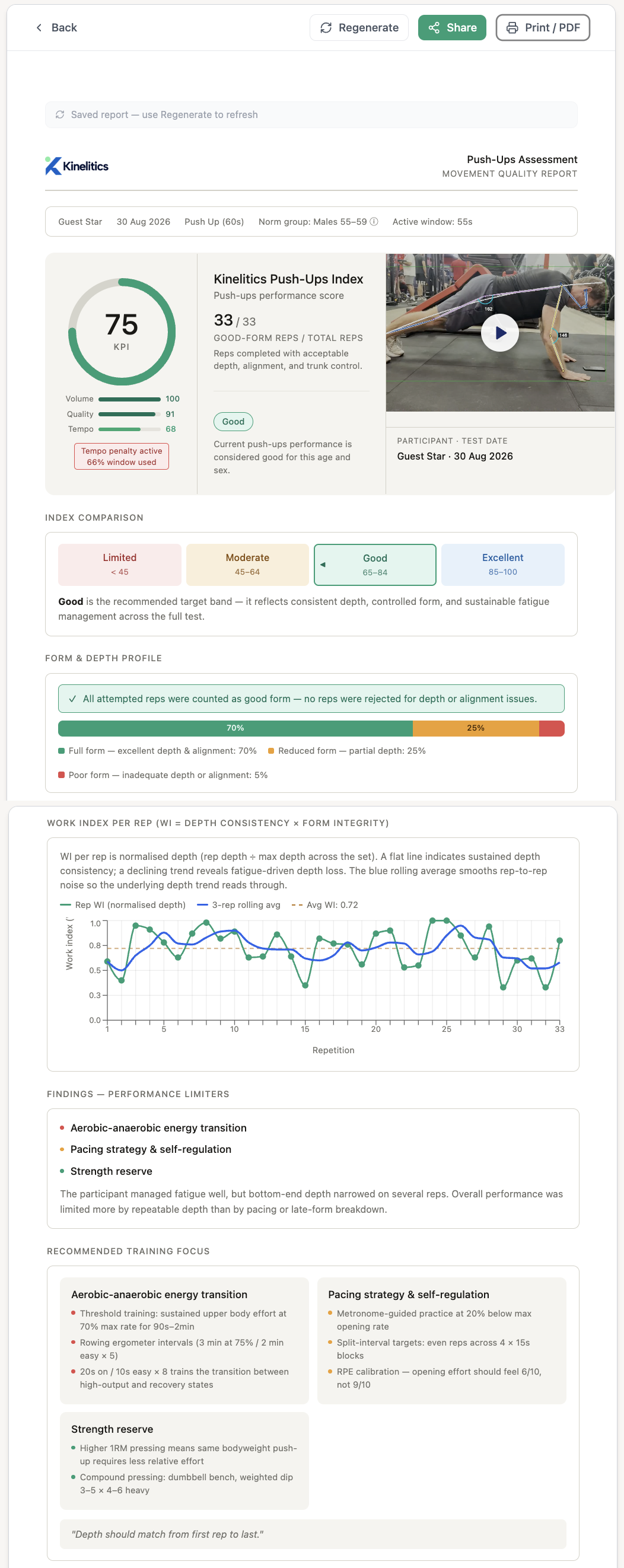
Both pages of a Kinelitics push-ups assessment. The first scores a Push-Ups Index of 75 from volume 100, quality 91 and tempo 68, places it in the Good band of four, and reports 70 per cent full form, 25 per cent reduced and 5 per cent poor. The second plots a work index for each of 33 repetitions against a rolling average, names three performance limiters: the aerobic-anaerobic transition, pacing and self-regulation, and strength reserve, and gives a recommended training focus under each.
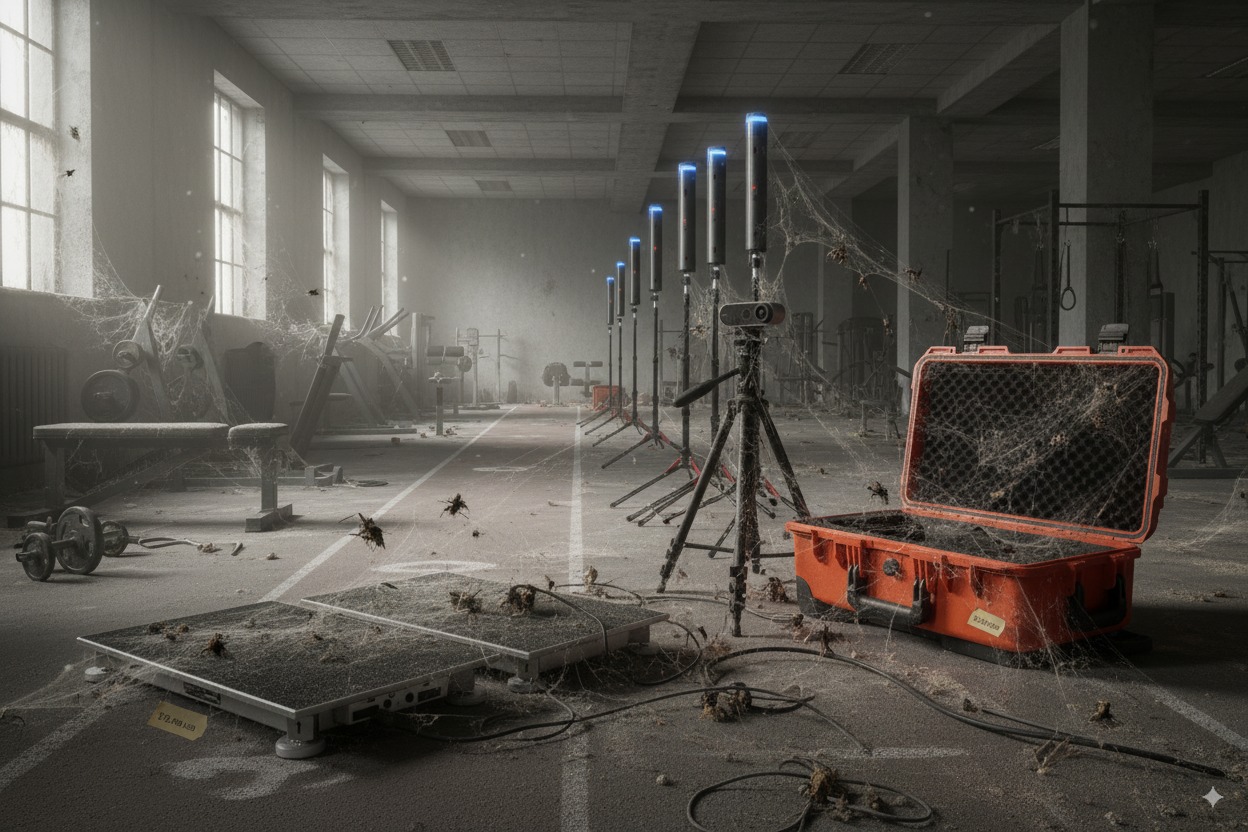
The equipment you have to book, share and recalibrate.
Test a whole squad in one room
One device does the observing, assessing and measuring, so there is nothing to share between clients and nothing to recalibrate. Test a squad or a class in parallel, in the room you are already in.
No clipboards, no typing up. The guidance comes from the client's actual test results, not a general purpose model.
Test, report and prescribe in one sitting.
One test is a number. Ten is a trajectory.
- History that builds itself
- Every result lands on a timeline you can show a client. Nobody types anything in.
- Real change, not noise
- Every shift is measured against known test-retest variation, so you know when a result has actually moved.
- Three comparisons, one result
- Age and sex norms, the client's own baseline, or the rest of their caseload.
Read the numbers
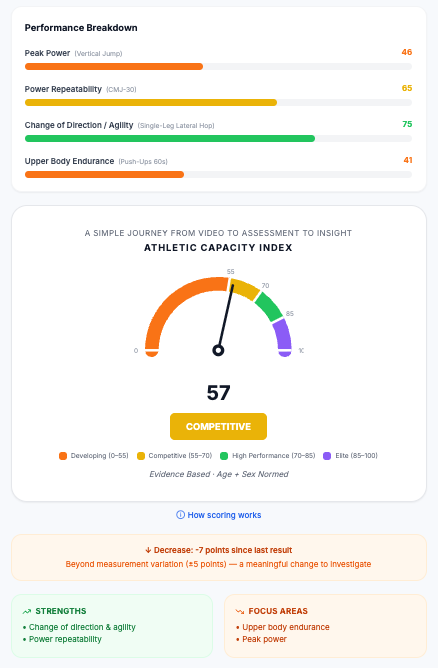
A Kinelitics Athletic Capacity Index report. A performance breakdown scores peak power 46 from a vertical jump, power repeatability 65 from a 30-second countermovement jump, change of direction and agility 75 from a single-leg lateral hop, and upper body endurance 41 from 60 seconds of push-ups. An overall index of 57 reads Competitive on a four-band gauge, evidence based and age and sex normed. A seven-point decrease since the last result is flagged as beyond measurement variation. Strengths are change of direction and power repeatability; focus areas are upper body endurance and peak power.
Read the numbers
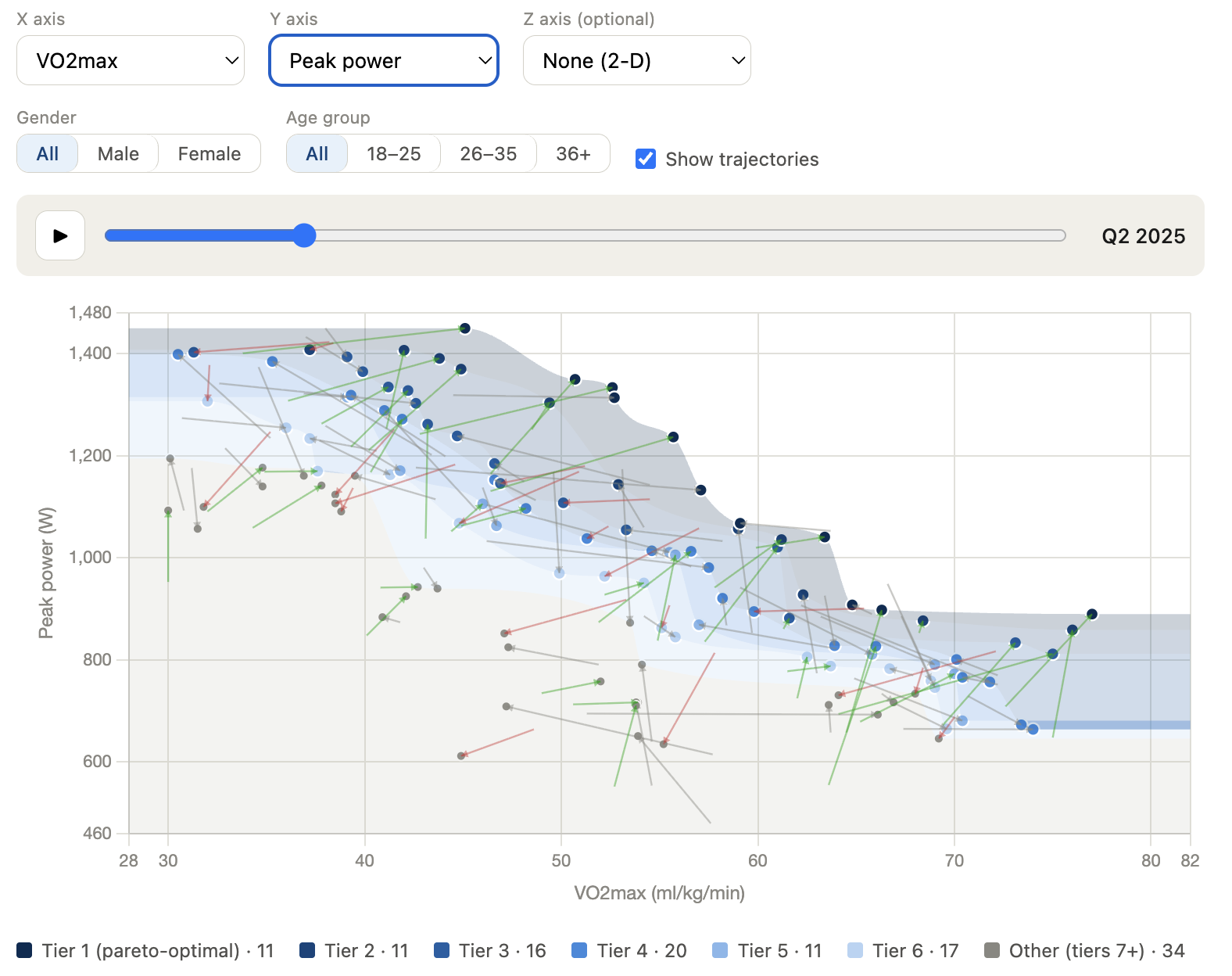
A Kinelitics cohort analysis screen. A scatter plot sets VO2max in millilitres per kilogram per minute against peak power in watts for a cohort of 120 people, with selectable axes, filters for gender and age group, and a quarterly timeline slider set to Q2 2025. Each point carries a trajectory line showing where that person has moved since earlier quarters, and a shaded band marks the leading edge of the cohort.
Who it's for
Built for practitioners
Allied health
Exercise physiologists and physios in chronic disease, aged care, disability and rehab.
Join the waitlistSport science
Sport scientists and S&C coaches in academies, schools and community sport.
Join the waitlistGyms and active health
Gym instructors and personal trainers working on health and performance goals.
Join the waitlist
In practice
Queensland's biggest athlete talent search
The Queensland Academy of Sport runs its statewide talent identification programme on this technology, deployed as YouFor2032, the largest remote athlete screening programme the state has run.
Anyone aged 13 and over can complete a validated assessment at home or at school. What used to need an AIS-calibre lab now runs on a phone.

Delivered in partnership with the Queensland Academy of Sport and the Queensland Government.
QAS athletes being screened for YouFor2032
The science behind it
Validated against laboratory motion capture at the University of Queensland, and deployed at state scale by the Queensland Academy of Sport. The studies are public and we will name them.
The research and validationA free report from thirty seconds of squats
Film a client doing as many good-form squats as they can in thirty seconds, and send it to us. This is what comes back: an index score, how well form held across the set, and how the reps were paced.
Free squat test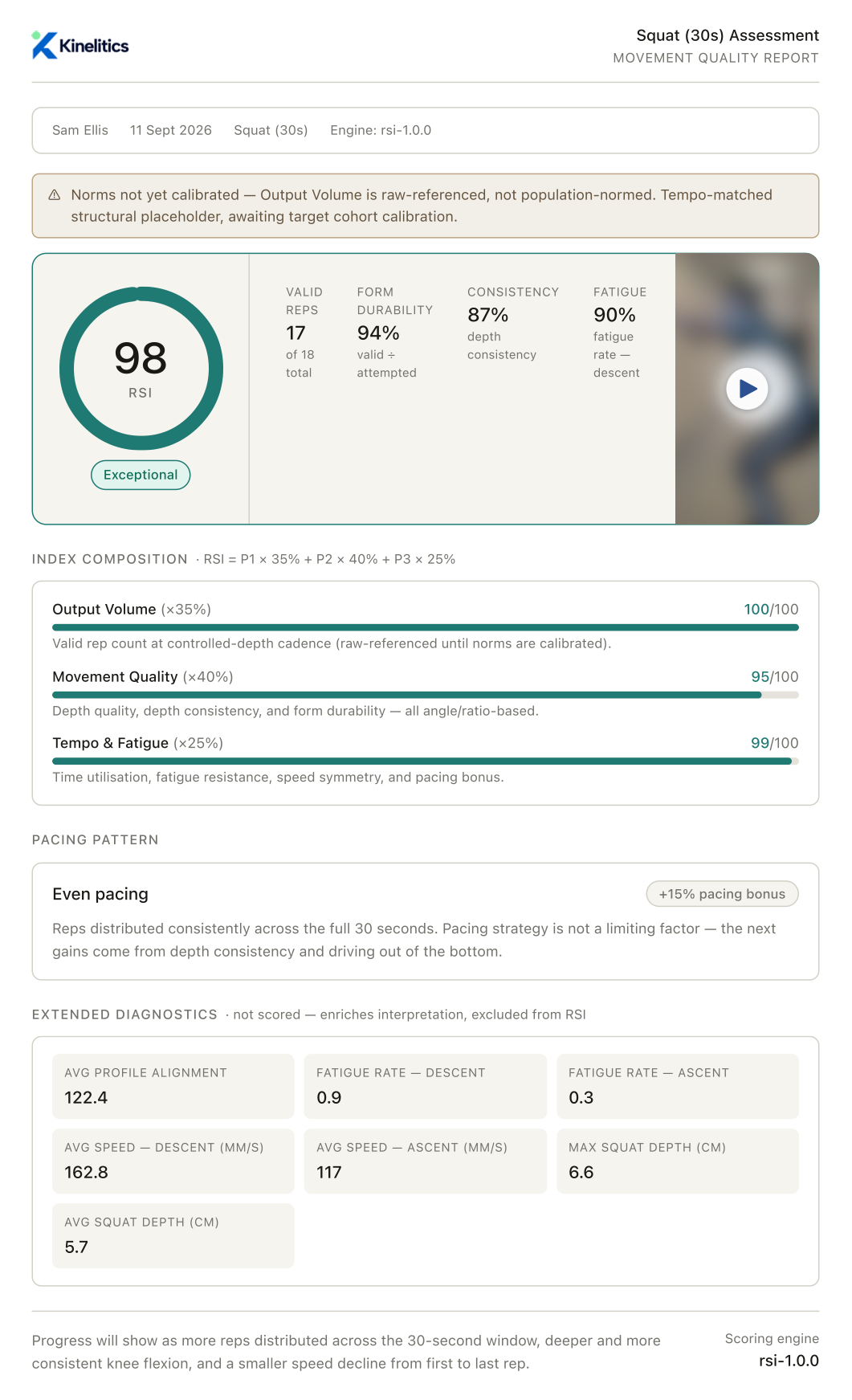
Read the numbers
An index score of 98 out of 100, rated Exceptional. 17 valid reps of 18 attempted, form durability 94%, depth consistency 87%, fatigue 90%. Index composition: output volume 100 of 100 weighted at 35%, movement quality 95 weighted at 40%, tempo and fatigue 99 weighted at 25%. Even pacing across the 30 seconds, earning a 15% pacing bonus. Extended diagnostics, not scored: average profile alignment 122.4, fatigue rate 0.9 on the descent and 0.3 on the ascent, average speed 162.8 mm/s descending and 117 mm/s ascending, squat depth 5.7 cm on average and 6.6 cm at most.
Get early access
We are onboarding practitioners now. Tell us who you are and what you test.
Evaluating this for an institution?
Talk to us about a deployment rather than joining a list. We will come back to you directly, not through a queue.
Talk to us